☰
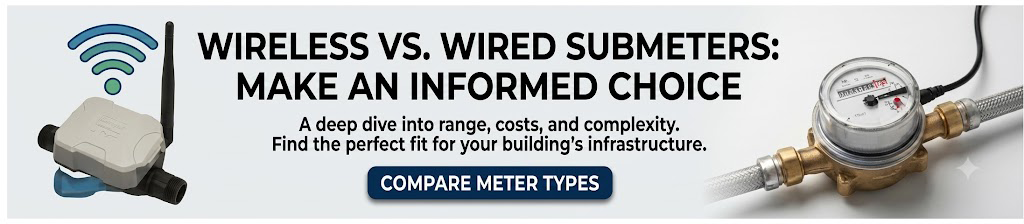
Selecting a water submeter is about more than choosing a meter body or deciding whether the device has a radio. The communication architecture behind a water submetering system determines how reads are collected, how quickly data becomes available, how much infrastructure the property must maintain, and whether the system can support billing, alerts, and long-term operational visibility. For multifamily owners, the wired-versus-wireless decision often comes down to building layout, installation constraints, coverage, desired data frequency, maintenance requirements, and budget. Wired submeters can provide a durable communication path when cable routes are accessible and a building is undergoing construction or major renovation. Wireless water meters can reduce cabling needs and make retrofit projects more practical, but they require careful planning for signal strength, endpoint placement, battery life, network reliability, and cybersecurity. The terms AMR and AMI are also often used interchangeably, even though they describe different levels of metering capability. Automated meter reading, or AMR, generally automates collection of meter data but may still require a person or vehicle to gather readings. Advanced metering infrastructure, or AMI, combines meters, communications, and data management to transmit information through a fixed network and can enable more frequent, two-way communication. Cellular and Wi Fi are not simply interchangeable wireless options either. A cellular water meter may avoid dependence on a property’s local internet network, while Wi Fi may be practical only where coverage, credentials, uptime, and network governance are dependable. The right answer is not the newest technology in isolation. It is the architecture that gives your property reliable reads, manageable installation, actionable data, and predictable long-term ownership.
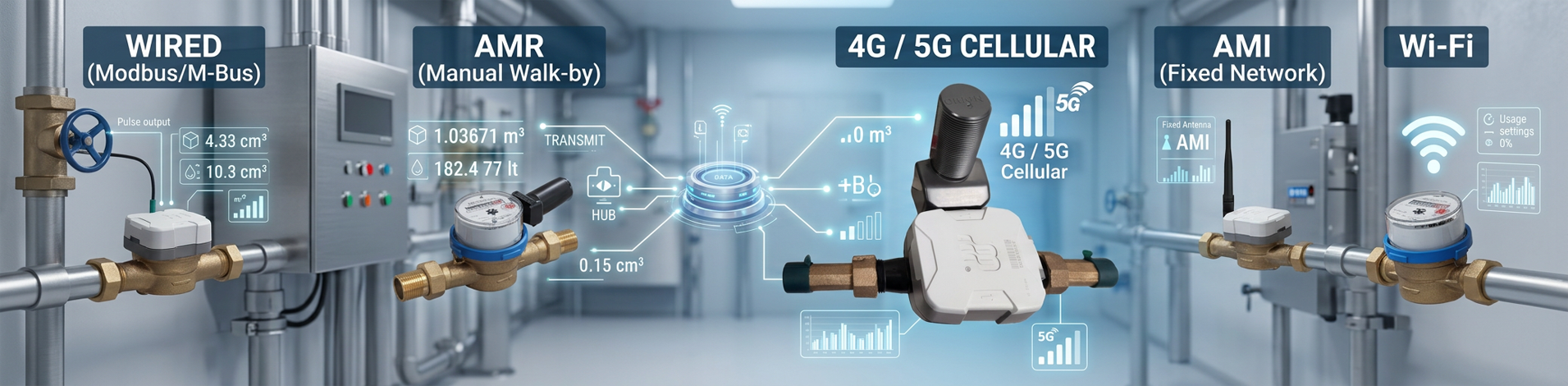
Wired water submeters communicate through physical cabling, which can be advantageous in new construction, major renovations, or buildings with accessible pathways. A wired design can provide reliable communication without relying on radio propagation through concrete, metal, dense walls, underground spaces, or long building footprints. However, the cost and disruption of pulling cable through an occupied existing property can be substantial.
Wireless water submeters use radio, cellular, Wi-Fi, or another communication method to transmit reads. They are often attractive for retrofit projects because they reduce—or eliminate—the need for dedicated communication cabling. Yet “wireless” is not a guarantee of simplicity. A property assessment should test coverage in meter rooms, crawl spaces, basements, utility closets, concrete structures, remote buildings, and other signal-challenging locations.
The decision should be based on a site survey rather than a generic product comparison. Consider the number of meters, property acreage, building construction, access restrictions, utility room locations, resident disruption, required data interval, expected expansion, installer access, and the cost of maintaining the communication infrastructure over the system’s life.
AMR, or automated meter reading, automates the collection of meter data. In many AMR systems, a meter endpoint transmits data that a field worker retrieves through walk-by or drive-by collection. Badger Meter describes AMR as communication technology used to automatically collect water-consumption and status data, with some systems relying on personnel in proximity to the device to collect it. AMI, or advanced metering infrastructure, is a broader system that connects meters, communications networks, and data-management tools. It can transmit data directly at defined intervals without requiring a manual drive-by collection process. AMI supports more timely visibility and can enable two-way communication, depending on the architecture and device capabilities. For a multifamily property, AMR may be appropriate when periodic reads are sufficient and the operating team can reliably collect them. AMI may be a better fit when the objective is remote meter reading, frequent consumption data, centralized portfolio visibility, timely exception alerts, and reduced dependence on manual collection. The preferred approach depends on the property’s data needs and long-term operating model—not just the label on the equipment.
Wi-Fi-enabled meters connect through a local wireless network. This can be useful in controlled environments, but it creates dependencies: routers and access points must provide coverage; passwords and credentials must remain current; network changes must be managed; firewalls must allow required communications; and property staff must be prepared to troubleshoot connectivity. In an apartment setting, resident Wi-Fi should never be treated as the foundation of a building-critical metering system. A cellular water meter uses a cellular network to transmit data. The primary advantage is separation from the property’s local network. If coverage is available, cellular endpoints can reduce the need to install and maintain gateways, repeaters, or building Wi-Fi infrastructure. This can be especially valuable for geographically dispersed properties, older buildings, mobile home parks, remote meter locations, and portfolios where ownership wants a more standardized deployment model. Cellular does require an assessment of signal strength, service availability, data-plan costs, device battery life, and long-term network technology compatibility. It is not automatically superior in every location. But for many retrofits, it can offer a cleaner path to remote water meter reading and smart water monitoring because the meter communications are not dependent on the property’s internet hardware or resident-managed networks.
Not sure whether your property needs wired, wireless, AMR, AMI, cellular, or Wi-Fi water meters? Request a Kaptech Connectivity and Submetering Assessment.
Let Kaptech Water Submetering show you and your team how water submetering can deliver increased tenant fairness, NOI and water conservation for your property. Shift the financial responsibility for water to your tenants!